August 25, 2026
Robotic Operating Rooms: How Surgical Robots Are Reshaping the Modern OR
Robotic Operating Rooms: How Surgical Robots Are Reshaping the OR
The operating room is undergoing the most significant transformation since the introduction of minimally invasive surgery. At the center of this shift are surgical robots — not as standalone devices, but as the anchor of an entirely new surgical ecosystem known as the robotic operating room. From precision instrumentation to intelligent patient positioning, every component in the OR is being reimagined to work in concert with robotic systems.
This article explores the key trends driving the adoption of robotic operating rooms, the evolving role of the surgical table, and what hospitals, surgery centers, and medical equipment buyers should watch as this space accelerates.
SURGICAL ROBOTS MARKET
PROJECTIONS (2025-2030)
The global surgical robots market, valued at US$11.98 billion in 2024, stood at US$13.69 billion in 2025 and is projected advance at a resilient at CAGR of 14.7% from 2024 to 2030, culminating in a forecasted valuation of US$27.14 billion by the end of the period.
Country
2025 Value
(USD Million)
2030 PROJECTED VALUE
(USD Million)
CAGR (2025-2030)
United States
$4971.2
$10246.5
15.6%
Japan
$547.2
$1142.0
15.9%
France
$357.9
$710.2
14.7%
Germany
$342.8
$685.1
14.9%
China
$320.9
$680.5
16.2%
Italy
$319.1
$626.4
14.4%
United Kingdom
$180.8
$347.2
13.9%
Canada
$177.7
$324.0
12.8%
India
$117.0
$251.1
16.5%
South Korea
$91.0
$186.3
15.4%
Australia
$85.3
$173.2
15.2%
Spain
$78.7
$147.8
13.4%
Brazil
$77.7
$145.6
13.4%
Mexico
$16.4
$30.4
13.1%
The Rise of Surgical Robots: From Novelty to Standard of Care
Surgical robots have moved far beyond the experimental phase. Over the past decade, robotic-assisted procedures have expanded from urology and gynecology into general surgery, orthopedics, thoracic surgery, and beyond. The reasoning is straightforward: robotic systems offer surgeons enhanced dexterity, tremor filtration, three-dimensional visualization, and the ability to operate through smaller incisions than traditional laparoscopy allows.
For patients, this translates to less tissue trauma, reduced blood loss, shorter hospital stays, and faster recovery times. For healthcare providers, it means higher throughput, better outcomes data, and a competitive edge in attracting both patients and top surgical talent.
But a surgical robot alone does not make a robotic operating room. The real trend is the integration of the robot with the full OR environment — lighting, imaging, the surgical table, anesthesia systems, and data networks — into a unified, intelligent surgical workspace.
What Defines a Robotic Operating Room?
A robotic operating room is not simply a conventional OR with a robot parked in the corner. It is a purpose-built environment engineered around the robotic workflow. Key characteristics include:
Optimized spatial layout. Surgical robots require significant floor space and clear lines of movement for robotic arms. Room design must accommodate docking, sterile field maintenance, and rapid repositioning without cable entanglement.
Integrated imaging and visualization. Robotic procedures rely heavily on high-definition, 3D, and increasingly augmented-reality visualization. The robotic OR consolidates these feeds into a single surgeon-controlled interface.
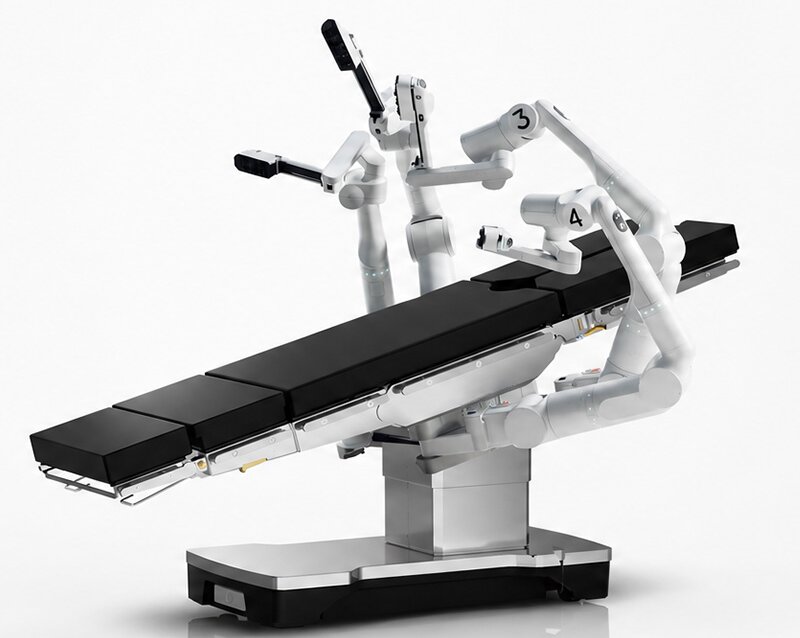
Intelligent surgical table positioning. The surgical table is no longer a passive platform. In robotic surgery, precise patient positioning is critical — the table must interface with the robotic system to allow coordinated movement, maintain surgical access, and support intraoperative repositioning without breaking sterility.
Connected data infrastructure. From preoperative imaging to postoperative analytics, the robotic OR generates and consumes large volumes of data. Integration with hospital information systems, PACS, and surgical video archives is becoming standard.
The convergence of these elements is what distinguishes a true robotic operating room from a conventional one with a robot added as an afterthought.
The Surgical Table: An Overlooked Critical Partner in Robotic Surgery
When the conversation turns to surgical robots, the surgical table is rarely the first component mentioned. Yet in practice, it is one of the most consequential pieces of equipment in the robotic OR.
Here is why:
1. Positioning Determines Access. Robotic arms have defined reach envelopes and joint limits. If the patient is not positioned correctly on the surgical table, the robot may be unable to reach the target anatomy without colliding with the patient, the table, or other instruments. A table with modular, motorized positioning — including Trendelenburg, lateral tilt, and height adjustment — gives the surgical team the flexibility to optimize the robot's working angle.
2. Stability Under Load. Robotic procedures can last several hours. The surgical table must maintain rigid stability throughout, because any drift or flexion can compromise the robot's precision. Tables designed with robust electro-hydraulic or electromechanical drives and high load capacities are essential.
3. Imaging Compatibility. Many robotic procedures rely on intraoperative fluoroscopy or CT. The surgical table must be radiolucent across its full length, with imaging-friendly tabletop materials and a base design that does not obstruct C-arm movement.
4. Coordinated Movement. The next frontier is tables that communicate directly with surgical robots. When the table can be repositioned during a procedure in coordination with the robot's adjusted trajectory — without requiring the surgeon to break scrub or manually re-dock — efficiency and safety both improve.
For medical equipment buyers evaluating an OR upgrade, the surgical table is not a commodity decision. It is a strategic one that directly affects robotic surgical outcomes.
Five Trends Shaping the Future of Robotic Operating Rooms
Trend 1: Broader Clinical Adoption Across Specialties
Surgical robots are no longer confined to a handful of specialties. Orthopedic robots for joint replacement, spinal robots for pedicle screw placement, and soft-tissue robots for general and colorectal surgery are all seeing rapid uptake. As platforms diversify, hospitals are investing in robotic operating rooms that can flex across multiple surgical disciplines rather than serving a single use case.
Trend 2: OR Integration as a Requirement, Not a Luxury
The days of bolt-on integration are ending. Modern robotic operating rooms are designed from the ground up with integrated surgical tables, boom-mounted displays, centralized control systems, and unified video routing. The goal is a single, seamless environment where the surgeon controls visualization, table position, lighting, and documentation from one interface. This operating room integration reduces cognitive load, shortens turnover time, and minimizes the risk of human error.
Trend 3: Artificial Intelligence and Machine Learning
AI is entering the robotic OR on multiple fronts. Computer vision algorithms are beginning to assist with anatomical recognition, instrument tracking, and surgical phase identification. Predictive analytics can flag potential complications before they escalate. And AI-assisted planning tools are helping surgeons map robotic trajectories preoperatively with greater accuracy than ever before.
Trend 4: Miniaturization and Cost Reduction
Early surgical robots were large, expensive, and complex to maintain. The current trend toward more compact, modular, and cost-accessible systems is lowering the barrier to entry. This is particularly significant for ambulatory surgery centers and hospitals in emerging markets, where space and capital are constrained but demand for robotic precision is growing.
Trend 5: Data-Driven Surgical Performance
Every robotic procedure generates a rich data stream — instrument kinematics, video, physiologic monitoring, and table positioning data. Forward-looking institutions are using this data to benchmark surgeon performance, identify workflow bottlenecks, and drive continuous quality improvement. The robotic operating room is becoming as much a data platform as a surgical environment.
What This Means for Hospitals and Medical Equipment Buyers
If you are planning an OR renovation or a greenfield surgical suite, the rise of robotic operating rooms changes the procurement calculus. Here are the answers to the questions buyers ask most:
Why should hospitals plan for OR integration from day one?
Retrofitting a conventional OR to accommodate a surgical robot is expensive and often compromises functionality. Design the room around the robotic workflow — including ceiling-mounted booms, reinforced floors, dedicated data pathways, and a surgical table with robotic-compatible positioning.
Should the surgical table be treated as a standalone product?
No. Evaluate the surgical table as a robotic partner, not a standalone product. Load capacity, radiolucency, motorized articulation, and future connectivity should all factor into the selection criteria.
How can an OR stay future-proof as robotic platforms evolve?
Prioritize flexibility. Robotic platforms evolve quickly. An OR designed with modular infrastructure — movable booms, interchangeable table tops, scalable IT capacity — will adapt to the next generation of surgical robots without a full rebuild.
Why is staff training critical to robotic OR success?
The technology is only as effective as the team operating it. Robotic OR success depends on coordinated training across surgeons, nurses, anesthesiologists, and biomedical engineering staff.
The Bottom Line
The robotic operating room represents a fundamental rethinking of how surgery is performed, not merely a new tool added to an old setup. Surgical robots are the headline, but the real story is the integration of every OR component — from imaging to lighting to the surgical table — into an intelligent, coordinated surgical environment.
 sales@vg-med.com
 Language