What Is a C-Arm Compatible Operating Table? Applications and Selection Tips
Nov 03, 2026
In modern operating rooms, medical imaging is often needed during surgery rather than only before or after a procedure. Surgeons may rely on real-time X-ray or fluoroscopic imaging to check bone alignment, guide instruments, verify implant placement, and assess surgical results. To make this possible, the operating table must provide enough space and imaging access for a C-arm system.
A C-arm compatible operating table is designed to support surgical procedures that require intraoperative imaging. It typically combines a radiolucent tabletop with a structure that allows the C-arm to move around or beneath the patient. However, not every operating table described as radiolucent is automatically compatible with every C-arm configuration.
For hospitals, surgical centers, medical equipment distributors, and healthcare project contractors, understanding these requirements is important when purchasing an imaging compatible surgical table. This guide explains how C-arm compatible operating tables work, where they are used, and what to check before selecting a model.
1. What Is a C-Arm Compatible Operating Table?
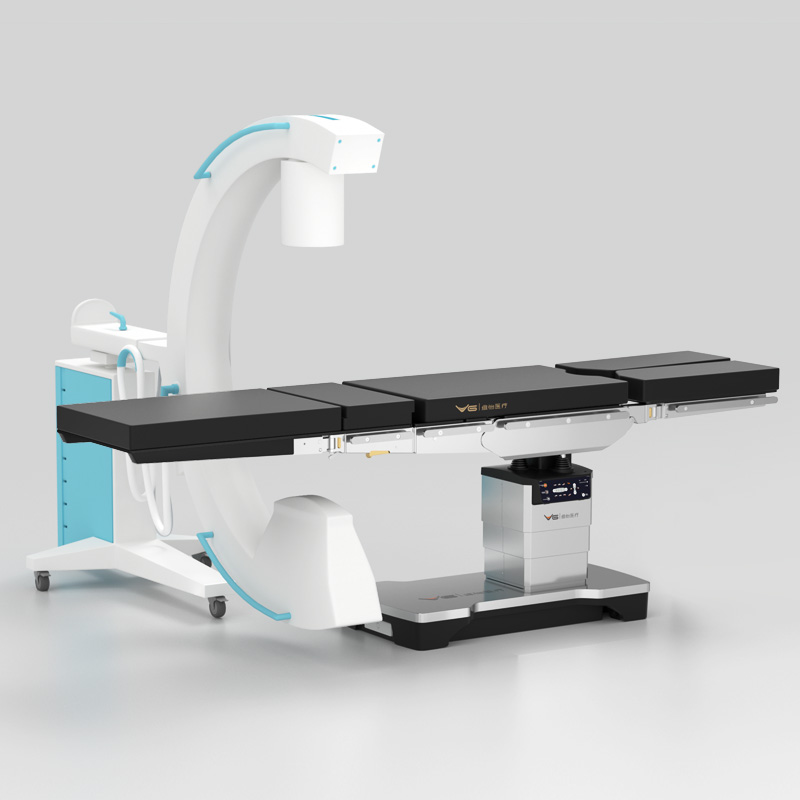
A C-arm compatible operating table is a surgical table designed to accommodate mobile C-arm imaging equipment during an operation. A C-arm is a mobile fluoroscopy system with an X-ray source and detector connected by a C-shaped arm. It produces real-time images that help surgeons visualize internal anatomical structures during procedures.
For the imaging system to work effectively, the operating table must provide two essential conditions:
Radiolucent tabletop: The tabletop allows X-rays to pass through with minimal attenuation and imaging interference. Carbon fiber composite is commonly used in imaging-oriented surgical tabletops because of its favorable radiographic properties.
Adequate C-arm clearance: The table structure must provide sufficient space for the C-arm to approach the patient, rotate, and move into different imaging positions without obstruction from the base, column, or other structural components.
Some tables also feature longitudinal sliding tabletops. This function allows the patient to be repositioned along the table without moving the entire base, helping create a larger imaging area for procedures that require multiple views.
In simple terms, a C-arm compatible operating table must support both image transmission and practical imaging access. These two requirements should always be evaluated together.
2. What Makes an Operating Table Radiolucent?
A radiolucent operating table is designed to minimize interference with X-ray imaging. Unlike conventional metal tabletops or structures that may block X-rays or produce unwanted artifacts, a radiolucent tabletop uses materials that allow imaging beams to pass through more effectively.
Carbon fiber composite is widely used for this purpose. It offers a combination of mechanical strength, relatively low X-ray absorption, and structural stability, making it suitable for operating tables used in fluoroscopy-guided procedures.
However, radiolucency is not determined by the tabletop material alone. Buyers should also pay attention to the following design details:
Imaging window: Check the length and width of the radiolucent area to confirm that it covers the required anatomical region.
Structural components: Identify whether metal frames, support rails, or other components may interfere with the intended imaging path.
Longitudinal movement: A sliding tabletop can help position different body regions within the imaging window.
Imaging quality: Ask for technical information or test results showing the tabletop's radiographic performance under the intended imaging conditions.
A radiolucent tabletop improves imaging access, but it does not automatically guarantee complete C-arm compatibility. The base design, column position, imaging window, and C-arm geometry must also work together.
COMFORT 300 SERIES – Radiolucent tabletop with sliding function
3. Common Applications of C-Arm Compatible Operating Tables
C-arm compatible operating tables are particularly useful in surgical specialties where real-time imaging helps guide instrument placement, anatomical positioning, or implant installation.
1. Orthopedic and trauma surgery
Orthopedic surgeons frequently use C-arm imaging to evaluate fractures, check bone alignment, and confirm the positioning of fixation devices. During procedures such as fracture reduction, intramedullary nailing, and internal fixation, the ability to obtain multiple imaging views without repeatedly repositioning the patient is valuable.
2. Spine surgery
Spinal procedures often require precise visualization of vertebral structures and implant positions. Fluoroscopy can help surgeons guide instruments and verify the placement of screws and other implants. A radiolucent tabletop with sufficient imaging access supports these procedures.
3. Urology and endourology
Some urological procedures use fluoroscopy to visualize the urinary tract and guide instruments. An operating table with appropriate positioning functions and imaging access can support procedures that require lithotomy or other specialized positions.
4. Vascular and interventional procedures
In selected vascular and minimally invasive procedures, C-arm imaging helps clinicians visualize vessels, guide devices, and monitor instrument positioning. The operating table should provide sufficient imaging access while maintaining patient stability.
5. Pain management and minimally invasive surgery
Fluoroscopy-guided injections, nerve blocks, and other minimally invasive interventions may require accurate imaging of specific anatomical structures. A suitable imaging table helps clinicians position the patient and access the target area more efficiently.
Although these specialties share a need for imaging access, their positioning requirements and equipment configurations can differ. Hospitals should select a table based on their actual procedure mix rather than assuming one configuration will suit every department.
4. Key Features to Look for in an Imaging Compatible Surgical Table
When comparing different surgical table models, buyers should look beyond the basic description of C-arm compatibility. The following specifications can have a direct impact on daily clinical use.
Radiolucent tabletop design
Check whether the tabletop is radiolucent across its full length or only within a designated imaging window. Ask about the material, imaging area, and radiographic performance. For procedures requiring different imaging angles, a larger usable imaging area may be beneficial.
Longitudinal sliding function
A sliding tabletop allows the patient to move relative to the table base. This is particularly useful when imaging different sections of the body. Before purchasing, compare the total sliding distance and the actual imaging space available in the intended patient position.
C-arm clearance and base configuration
The C-arm must be able to reach the required imaging positions without colliding with the table base or column. Consider the table's T-shaped or other base design, column position, and the dimensions of the mobile imaging equipment.
Patient positioning flexibility
Procedures may require supine, prone, lateral, or specialized surgical positions. Adjustable backplates, removable leg sections, Trendelenburg movement, and lateral tilt can help accommodate different clinical workflows.
Safe working load and stability
The table's rated safe working load should match the patient population and intended procedures. Buyers should also check the permitted load under different articulated positions, as well as stability during movement and imaging.
Accessories and modular configuration
Orthopedic traction systems, head supports, arm boards, leg supports, and other attachments may be required depending on the surgical specialty. Confirm compatibility with the table model and whether the accessories can be installed without restricting C-arm access.
VCARE 5000 / 7000 SERIES – Modular electric operating table
5. How to Choose the Right C-Arm Compatible Operating Table
Selecting an appropriate table starts with understanding the hospital's clinical requirements. Here are five practical steps for procurement teams and operating room planners.
Step 1: Identify the main surgical applications.
List the procedures that will be performed regularly. An orthopedic trauma center may prioritize fracture positioning and imaging access, while a general hospital may need a more versatile table for several surgical specialties.
Step 2: Confirm C-arm compatibility with the actual imaging system.
Provide the operating table manufacturer with the C-arm model, dimensions, and required imaging positions. Ask for confirmation of clearance and access throughout the intended range of movement. A general statement of compatibility is not a substitute for checking the actual equipment combination.
Step 3: Compare the imaging window and sliding distance.
Check whether the radiolucent area covers the anatomical regions involved in your procedures. Review the longitudinal sliding range and determine whether the table can provide the required imaging access without compromising patient positioning.
Step 4: Evaluate positioning and load specifications.
Compare height adjustment, Trendelenburg and reverse Trendelenburg, lateral tilt, backplate movement, leg plate adjustment, and safe working load. These specifications should match the hospital's clinical requirements and patient population.
Step 5: Review maintenance, compliance, and after-sales support.
Ask about product certifications, installation requirements, preventive maintenance, spare parts availability, operator training, and warranty conditions. For international procurement projects, confirm that the documentation meets the regulatory requirements of the destination market.
6. VG Medical Operating Tables for Imaging-Related Procedures
Different surgical departments have different requirements for imaging access, patient positioning, and table load capacity. VG Medical provides a range of operating table solutions designed for modern operating rooms and multidisciplinary surgical applications.
The COMFORT 300 SERIES features a full radiolucent tabletop for C-arm and X-ray applications, with a longitudinal sliding function of at least 320 mm. Its electro-hydraulic system, adjustable positioning, and optional configurations make it suitable for orthopedic, urological, and neurosurgical applications. The product specifications list a maximum load of 280 kg.
The VCARE 2111 is a multifunctional electric-hydraulic operating table with a radiolucent modular tabletop, excellent X-ray transparency, and a 260 kg safe working load. Its sliding function is optional, so buyers should confirm the required configuration when requesting a quotation.
For hospitals requiring a higher-capacity modular operating table, the VCARE 5000 / 7000 SERIES offers safe working loads of up to 480 kg and 500 kg, respectively, along with multiple electric positioning functions and longitudinal movement. Imaging requirements and the exact table configuration should be confirmed with the manufacturer before selection.
VCARE 2111 – Electric-hydraulic operating table with radiolucent tabletop
When comparing these models, the most suitable option depends on the required imaging area, C-arm clearance, patient positioning, and load capacity. Reviewing the complete technical specifications is essential before placing an order.
7. Why C-Arm Compatibility Matters in Modern Operating Rooms
As intraoperative imaging becomes increasingly common across surgical specialties, operating tables need to do more than provide a stable surface for patient positioning. They must also work with imaging equipment and other operating room devices without creating unnecessary workflow restrictions.
A properly selected imaging compatible surgical table can help reduce the need for patient repositioning during imaging, provide better access to the surgical site, and support more flexible procedure planning. Its value comes from the combination of radiolucent materials, structural clearance, positioning functions, and compatibility with the hospital's imaging equipment.
VG Medical has specialized in operating room and ICU equipment manufacturing since 2003. Its product portfolio includes surgical lights, operating tables, medical ceiling pendants, and digital integrated operating room systems, supporting hospitals and medical equipment partners in international markets.
Whether you are equipping a new orthopedic operating room, upgrading an existing surgical department, or sourcing operating tables for distribution, selecting the right imaging configuration is an important part of long-term equipment planning.
For product specifications, model comparisons, or customized project requirements, contact the VG Medical team to discuss a suitable operating table solution.
Frequently Asked Questions
1. What is a C-arm compatible operating table?
A C-arm compatible operating table is designed to support intraoperative X-ray and fluoroscopic imaging. It generally features a radiolucent tabletop and sufficient structural clearance for the C-arm to access the patient from different angles.
2. What is the difference between a radiolucent and a standard operating table?
A radiolucent operating table uses imaging-friendly tabletop materials that allow X-rays to pass through with minimal interference. A conventional table may contain materials or structural components that obstruct imaging or create artifacts, depending on its design.
3. Which surgeries require an imaging compatible surgical table?
Common applications include orthopedic and trauma surgery, spine surgery, urology, selected vascular procedures, and fluoroscopy-guided pain management. The required table configuration depends on the imaging method and surgical positioning.
4. Is a radiolucent tabletop enough for C-arm compatibility?
No. Radiolucency is only one requirement. The table must also provide adequate C-arm clearance, an appropriate imaging window, and suitable positioning capabilities. Compatibility should be verified using the actual C-arm model and intended imaging positions.
5. Why is a sliding tabletop important for C-arm imaging?
A sliding tabletop allows the patient to move longitudinally relative to the table base. This can expand the usable imaging area and help position different anatomical regions within the C-arm's imaging range without moving the entire operating table.
6. What should buyers check before ordering a C-arm compatible surgical table?
Buyers should verify tabletop radiolucency, imaging window dimensions, sliding distance, C-arm clearance, patient positioning functions, safe working load, accessories, certifications, and after-sales support. The manufacturer's compatibility confirmation should be based on the intended imaging equipment.
 sales@vg-med.com
 Language