 sales@vg-med.com
 Language




What Are You Looking For?
Surgical Light with Camera: A Complete Buying Guide for Modern Operating Rooms
An operating room light does one job brilliantly: illuminate the surgical field. But today's ORs are asked to do much more — record procedures for training, stream surgeries for remote consultation, document cases for medico-legal files, and feed video into integrated OR systems.
That's where the surgical light with camera comes in. By combining shadowless LED illumination with a built-in camera system, one ceiling-mounted unit solves two problems at once — without adding another arm, cart, or cable to an already crowded OR.
In this guide, we explain how camera-equipped surgical lights work, who benefits from them, and the seven specifications you should check before purchasing one for your hospital or surgical center.
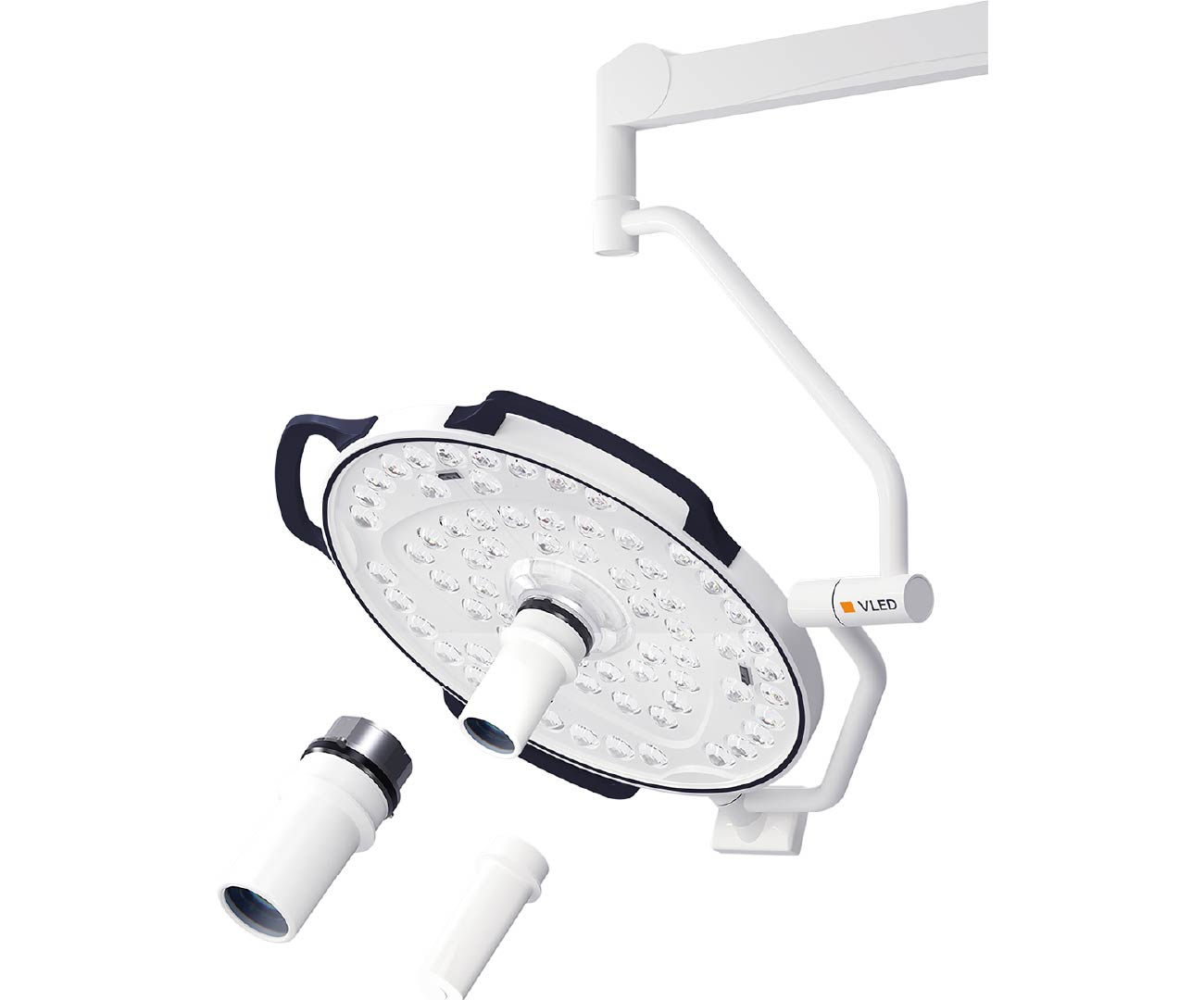
A surgical light with camera is an LED operating light with an integrated video camera housed inside (or mounted on) the lamp head. Positioned directly above the surgical site, the camera captures the same shadow-free, high-CRI view the surgeon sees — making it the most natural viewpoint in the entire operating room.
The camera feed can be:
Compared with handheld documentation cameras or overhead boom cameras, the surgical-light camera requires no extra floor space, no sterile-field intrusion, and no dedicated operator. Once positioned for lighting, the camera view follows automatically.
1. Surgical Education & Training
Teaching hospitals use light-integrated cameras to broadcast live procedures to lecture rooms, giving residents and medical students an unobstructed view of the operative field. Recorded footage becomes a reusable library of teaching material — from routine appendectomies to complex trauma cases.
2. Remote Consultation & Proctoring
In regions where specialist coverage is limited, a surgical light camera allows an off-site expert to observe a procedure in real time and advise the on-site team. For surgeons adopting new techniques, recorded proctoring sessions accelerate credentialing.
3. Clinical Documentation
Video provides an objective, timestamped record of each procedure — valuable for surgical logs, case reviews, quality committees, and medico-legal protection.
4. Better Team Coordination Inside the OR
Routing the camera feed to wall or boom monitors lets anesthesia, nursing, and circulating staff see exactly what the surgeon sees. Situational awareness improves, and instrument readiness improves with it.
5. Foundation for the Digital Integrated OR
Camera-equipped surgical lights are a natural entry point into the integrated OR. Combined with operating tables, ceiling supply units, and video routing systems, they let hospitals build a fully digital operating room step by step — rather than purchasing an expensive all-in-one integration in a single project.
6. Specifications to Check Before Buying
Not every "surgical light with camera" is engineered to the same standard. Evaluate these seven points before you commit:
|
Setting |
How the camera light is used |
|
Teaching hospitals |
Live procedure broadcasts to lecture halls; resident training libraries |
|
Regional / district hospitals |
Remote specialist consultation during complex cases |
|
Private surgical centers |
Procedure documentation and marketing-grade case footage (with consent) |
|
Trauma & emergency departments |
Time-stamped documentation of emergency interventions |
|
Veterinary & dental surgery |
Client education and case documentation |
VG Medical Technology has manufactured operating room and ICU equipment since 2003, with a product range spanning surgical lights, operating tables, ceiling supply units, and digital integrated OR solutions sold in global markets.
The VLED series surgical lights are built for camera integration, delivering the optical foundation that high-quality surgical video depends on:
Configured with a camera module and paired with VG Medical's digital integrated OR solution, the VLED series becomes a complete visual foundation for documentation, teaching, and remote collaboration — at the cost-efficiency that defines the VG Medical brand.
Explore the VLED series surgical lights or contact our team for camera configurations and integrated OR proposals.
1.Can a camera be added to an existing surgical light?
Depends on the model. Many modern modular LED lights accept a factory camera module; older lamps often require a bulky add-on camera arm that complicates positioning. If retrofitting, ask the manufacturer whether the camera is a native option and whether the suspension arm is rated for the added weight.
2.Does the camera interfere with sterilization or the sterile field?
No. The camera sits inside the lamp head above the sterile field, behind the same smooth, sealed surfaces that make the light easy to clean and disinfect. No additional intrusion into the surgical zone.
3.Is 1080p enough, or should we specify 4K?
For routine documentation and team monitors, 1080p is sufficient and keeps file sizes manageable. Choose 4K if your primary use is teaching, publication, or detailed deep-cavity visualization — and plan corresponding storage.
4.How does a surgical light camera connect to our recording or streaming system?
Typically via HDMI/SDI to an OR video recorder or through a network interface to a hospital video management system. Confirm output formats and integration protocols with both the light manufacturer and your AV integrator during planning.
5.Is a surgical light with camera more expensive than separate lighting + camera?
Usually the opposite over the full lifecycle. One ceiling unit replaces a light plus a separate camera boom, saves OR floor and ceiling space, simplifies installation, and eliminates a separate maintenance contract.
Need a surgical lighting and video solution tailored to your operating rooms? Contact VG Medical — our engineers support project planning, room layout, and integration from first consultation to installation.
leave a message
Scan To Wechat :

Scan To WhatsApp :