Surgical Table Positioning Guide: Safe Patient Positioning for Every Procedure
Aug 27, 2026
A practical surgical table positioning guide covering supine, prone, lateral, and lithotomy setups — plus safety checkpoints to protect patients and optimize surgical access.
A well-executed surgical table positioning routine is one of the most underrated factors in operative success. Correct positioning gives the surgeon clear access to the surgical site, supports anesthesia management, and protects the patient from pressure injuries, nerve damage, and circulation complications. This surgical table positioning guide breaks down the essentials: how a modern surgical table works, which positions suit which procedures, and the safety checkpoints every OR team should follow.
Why Surgical Table Positioning Matters
Patient outcomes are decided long before the first incision — often at the moment the patient is placed on the surgical table. Poor positioning has direct, measurable consequences:
Surgical access.An incorrectly angled surgical table can force the surgeon to work against gravity or reposition mid-procedure, extending operative time.
Patient safety. Pressure ulcers, brachial plexus injuries, and compartment syndrome are all traceable to inadequate padding and support on the operating table.
Imaging compatibility. Procedures that rely on intraoperative C-arm scanning require a radiolucent surgical table — metal components block X-rays and force staff to move the patient.
In short, positioning is not a setup task. It is a clinical decision that should be planned the same way the surgical approach is planned.
Understanding the Surgical Table: Key Positioning Components
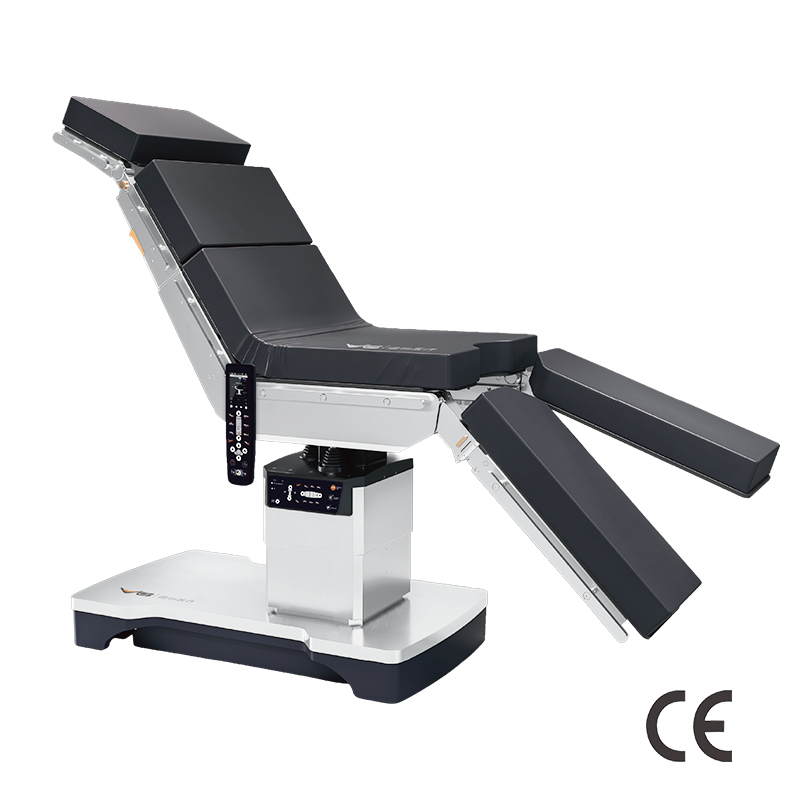
Before applying any position, it helps to know what a modern surgical table can actually do. Most electric and electro-hydraulic surgical tables share four core positioning capabilities:
1. Height adjustment — lowers for safe patient transfer, rises to ergonomically correct working height for the surgical team.
2. Trendelenburg / reverse Trendelenburg tilt** — pitches the patient head-down or feet-down to shift organs and blood distribution.
3. Lateral tilt— rolls the table left or right for procedures requiring oblique approaches.
4. Sectional articulation— independent back, seat, and leg sections enable fusion positions such as flexion, kidney bridge, and beach chair.
Accessories complete the system: positioning pads, headrests, arm boards, straps, and side rails. On tables designed for imaging-intensive procedures, carbon fiber tabletop modules replace standard sections so the C-arm can scan through the patient without repositioning.
Common Surgical Positions and When to Use Them
Supine (Dorsal) Position
The default position for abdominal, cardiac, and many laparoscopic procedures. The patient lies flat on the surgical table with arms secured on arm boards. Reverse Trendelenburg elevates the torso for upper-abdominal access; standard Trendelenberg is used in gynecologic and pelvic surgery.
Prone Position
Used for spine, posterior cranial, and some orthopedic procedures. Achieving prone safely requires coordinated log-rolling, chest rolls to free the abdomen, and head support that keeps the airway accessible. The surgical table must be set to its lowest height before turning.
Lateral Position
Common in thoracic, renal, and hip surgery. The patient is turned 90 degrees with an axillary roll under the lower arm and a vacuum mattress or positioning frame to lock the pelvis. Lateral tilt of the operating table fine-tunes surgical exposure.
Lithotomy Position
The standard for gynecologic, urologic, and colorectal procedures. Leg sections of the surgical table are removed or dropped and legs are placed in stirrups — simultaneously raising them, flexing the hips, and exposing the perineal area.
Fowler / Beach Chair Position
Back section raised, leg section lowered. Used for shoulder surgery and select ENT procedures. Beach chair position demands strict blood-pressure management because of cerebral perfusion risks.
Knee Position
Compared with the prone position, the knee position reduces abdominal compression, lowers intra-abdominal and epidural venous pressure, thereby minimizing intraoperative bleeding — especially beneficial for lumbar spine surgery.
Supine Position
Abdominal surgery
Cardiothoracic surgery
Head and neck surgery
Neurosurgery
Orthopedic surgery
Urological & gynecological surgery
Prone Position
Posterior spinal surgery
Posterior cranial fossa surgery
Anorectal surgery
Achilles tendon repair, posterior leg procedures
Lateral Position
Thoracic surgery
Renal surgery
Total hip arthroplasty
Neurosurgery
Lithotomy Position
Gynecological & obstetric surgery
Urological surgery
Colorectal / rectal surgery
Perineal surgery
Beach Chair Position
Shoulder arthroscopy
Rotator cuff repair
Total shoulder arthroplasty
Acromioplasty, shoulder instability surgery
Some ENT/ facial procedures
Knee Position
Anorectal surgery
Sacral/ coccygeal surgery
Posterior pelvic procedures
Posterior lumbar spine surgery
Step-by-Step Surgical Table Positioning Guide
This is the sequence experienced OR teams follow for safe, repeatable positioning:
1. Confirm the procedure and required position with the surgeon before the patient enters the room. Check the surgical table's weight capacity and accessory list against the plan.
2. Prepare the surgical table. Attach section inserts, arm boards, or stirrups. Verify the table is locked, on backup battery if needed, and responsive to the hand control.
3. Transfer at low height. Bring the operating table to transfer height and move the patient with sufficient staff support — this is where most transfer injuries occur.
4. Place the patient, pad the pressure points. Heels, sacrum, occiput, elbows: distribute pressure with gel or foam padding and check that no bony prominence contacts the table frame.
5. Secure limbs and check alignment. Fasten straps without compressing circulation, support the natural curve of the spine, and confirm neutral neck positioning.
6. Adjust table articulation. Apply Trendelenburg, lateral tilt, or sectional flexion in controlled increments, re-checking pressure points after each move — tissue tolerances shift when the surgical table tilts.
7. Verify imaging access. If the procedure uses a C-arm, sweep the arm through the planned arc before draping to confirm clearance and radiolucency.
8. Final time-out. Re-confirm position, padding, and strap placement with the full team before incision.
Positioning Safety Checklist
Run this checklist after every position change, not just the initial setup:
All bony prominences padded, no contact with rigid table parts
Eyes protected and free from pressure (prone: check before draping)
Arms: abduction under 90 degrees, palms up or neutral
Straps secure but distal pulses palpable
No limb or trunk crossing hardware or rail edges
Cable and accessory routing clear of the patient's skin
Surgical table brakes engaged and control functions tested
C-arm arc verified before draping (imaging procedures)
Choosing a Surgical Table That Supports Positioning
Not every operating table makes positioning easy. When evaluating a surgical table for your facility, prioritize:
Smooth, quiet electric articulation with a responsive hand control — jerky movements during Trendelenburg or lateral tilt disturb sterile setup and patient stability.
Modular carbon fiber sections for orthopedic and trauma rooms, allowing X-ray and C-arm imaging through the tabletop without repositioning the patient.
High weight capacity with low profile — bariatric-safe tables that still drop low enough for safe transfers.
Battery backup and quick-release accessories, so positioning never stalls mid-procedure.
As a reference point, VG Medical's VCARE surgical table series combines electro-hydraulic articulation with carbon fiber tabletop options and a full accessory ecosystem for positioning — a configuration typical of what modern OR suites now expect for multi-specialty use.
FAQ
What is the purpose of surgical table positioning?
Surgical table positioning aligns the patient so the surgical team gets optimal access to the operative site while keeping the patient physiologically stable and protected from position-related injuries such as pressure ulcers and nerve compression.
Which surgical position is the most common?
Supine (flat on the back) is the most common position on the surgical table, used for abdominal, cardiac, vascular, and many laparoscopic procedures. Lithotomy and lateral positions are the next most frequent.
Why is Trendelenburg position used in surgery?
Trendelenburg tilts the patient head-down by 15–30 degrees, shifting abdominal organs toward the diaphragm to improve pelvic exposure in laparoscopic surgery and support venous return in selected hemodynamic situations.
How does a surgical table affect C-arm imaging?
Standard metal table sections block X-rays. Radiolucent carbon fiber sections allow the C-arm to image the patient directly through the surgical table, so imaging can happen during the procedure without repositioning the patient or extending operative time.
How often should patient position be checked during surgery?
Positioning should be re-verified after every table articulation, and pressure points reassessed at least every two hours for long procedures — tissue perfusion changes as the operating table tilts or the patient shifts under draping.
What accessories support safe positioning on a surgical table?
Positioning pads, gel heel protectors, arm boards, headrests, stirrups, safety straps, and body straps are the core set. Vacuum mattresses and frame-based positioners are added for prone and lateral cases.
Conclusion
Consistent, checklist-driven positioning turns the surgical table from a piece of furniture into a clinical instrument. Plan the position with the surgeon, pad every pressure point, re-verify after every articulation, and choose an operating table engineered for smooth, radiolucent, multi-position use. Teams that treat positioning with this discipline see fewer position-related complications and faster, cleaner procedures.
Looking for a surgical table built for multi-position surgical workflows? Explore VG Medical's VCARE series — electro-hydraulic positioning, carbon fiber imaging modules, and MDR CE certified manufacturing with 20+ years of OR equipment expertise.
 sales@vg-med.com
 Language